What Is the MaicaTrades Market Score?
How one number turns market trend, momentum, sector strength, volatility, and breadth into clearer swing-trading context.
The problem the Market Score is designed to solve
A market can look strong on the surface while important conditions underneath are weakening. An index may still be above its moving averages, but momentum may be fading, fewer sectors may be participating, breadth may be deteriorating, and volatility may be rising.
That creates a practical problem for swing traders: there is too much market information to review quickly, and no single indicator tells the whole story. The MaicaTrades Market Score brings several important signals together and turns them into one clear reading without hiding the context behind it.
How the Market Score works
The score begins with four core components worth a combined 100 points. Market Breadth is then used as a confirmation layer so the final reading reflects whether apparent market strength is broadly supported.
1. Trend — up to 40 points
Trend carries the largest weight because the broader direction of the market matters most to swing traders. This component evaluates whether the major market indexes are holding constructive trend conditions rather than reacting only to one up or down session.
2. Momentum — up to 25 points
Momentum measures the strength and persistence behind current price action. A market can remain in a longer-term uptrend while short-term momentum weakens. That difference helps explain why Trend can stay strong even on a red day.
3. Sector Strength — up to 20 points
Healthy markets usually have meaningful participation across multiple sectors. When leadership narrows and most sectors are weak, the Sector Strength contribution falls—even if one or two heavyweight areas are holding up.
4. Volatility — up to 15 points
Volatility is the risk-pressure component. Calm, controlled conditions are generally more supportive of swing trades, while expanding volatility can signal uncertainty, wider price swings, and a greater need to protect capital.
5. Market Breadth — the confirmation layer
Market Breadth asks whether strength is widespread or concentrated. MaicaTrades tracks participation across its M122 market basket and compares advancing versus declining stocks, moving-average participation, the advance-decline line, and broad-sector participation. Breadth does not replace the four core components; it confirms or challenges the story they are telling.
A real example: why a strong trend can still produce a bearish score
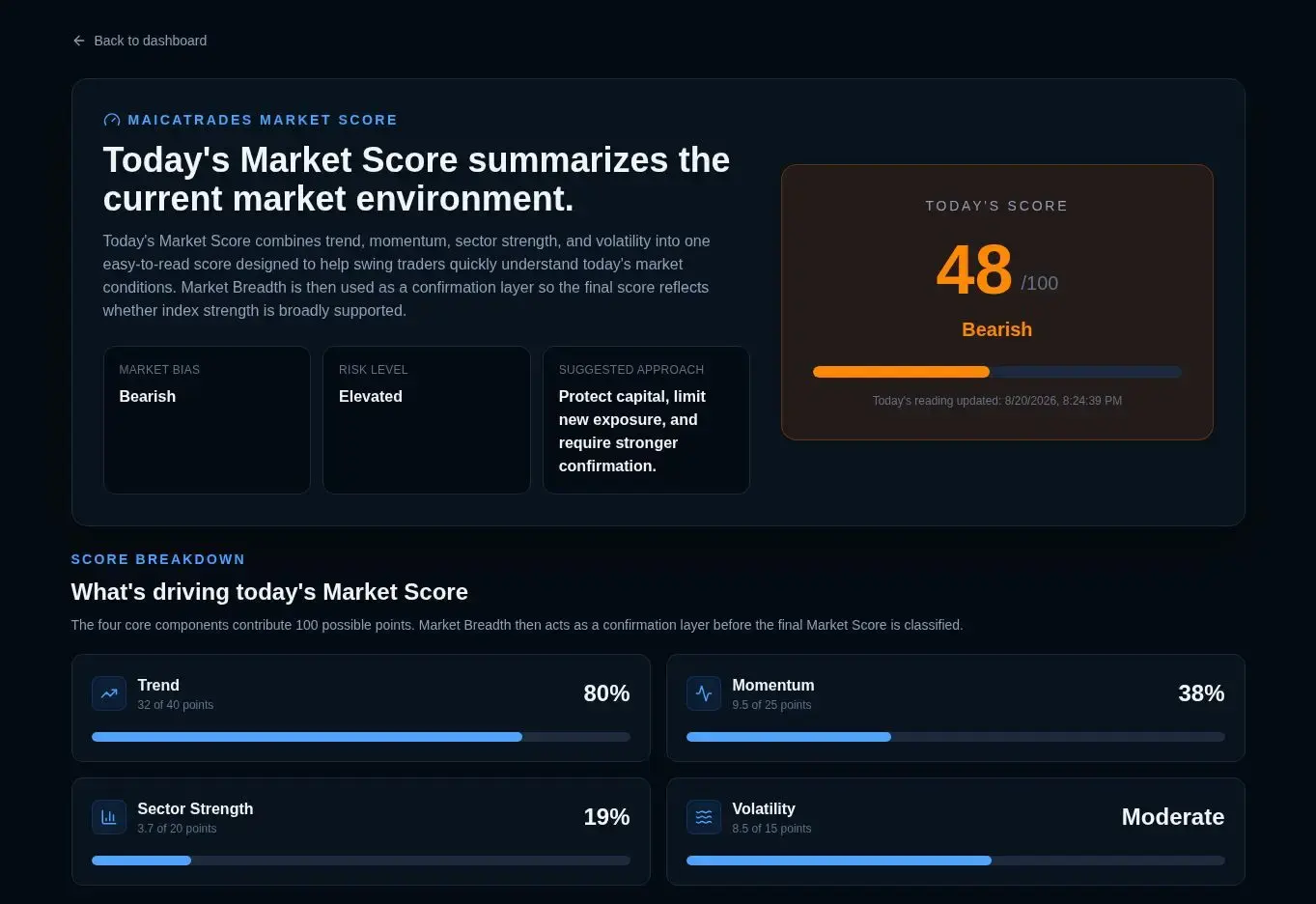
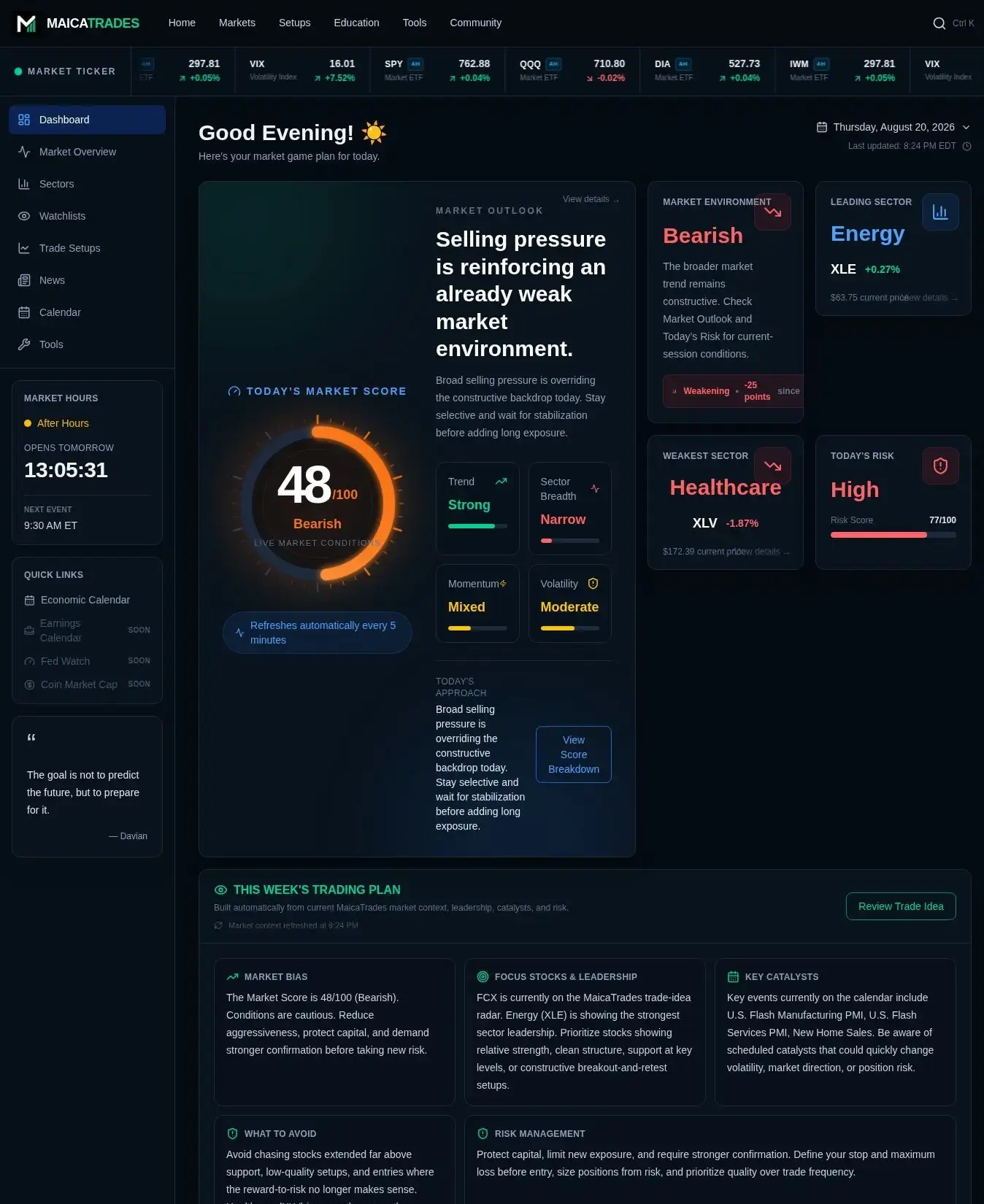
In the dashboard example captured on August 20, 2026, the Market Score was 48/100—classified as Bearish. Trend still contributed 32 of 40 points, showing that the broader structure remained relatively constructive. But the rest of the evidence was much weaker:
- Momentum: 9.5 of 25 points
- Sector Strength: 3.7 of 20 points
- Volatility: 8.5 of 15 points, classified as Moderate
- Market Breadth: 38/100, with only 27.1% advancing and 71.3% declining
- Broad sectors: only 1 of 11 positive
This is why the score is not just a trend indicator. Trend answers, “What is the broader structure?” The full Market Score asks, “How supportive is the complete environment right now?” On this day, selling pressure, weak participation, narrow sector strength, and higher volatility outweighed the remaining trend support.
What the score ranges mean
How swing traders can use it
- Start with the environment. Check the score before reviewing individual setups.
- Adjust exposure. Stronger conditions may support more exposure; weaker conditions may call for smaller positions or fewer trades.
- Demand alignment. Favor setups that agree with sector leadership, breadth, momentum, and current risk conditions.
- Use the breakdown. If the score changes, check which component moved instead of reacting to the number alone.
- Keep chart structure in control. The score supports trade decisions; it does not replace entries, stops, targets, catalysts, or position sizing.
What the Market Score is—and what it is not
The Market Score is a preparation tool, not a prediction machine. It does not tell traders that the market must rise or fall next. It organizes current evidence so traders can match their level of risk to the environment in front of them.
That is the MaicaTrades philosophy: depth without complexity. The calculations happen behind the scenes, while the dashboard presents a clear answer to the question busy swing traders need to ask each day: What kind of market am I trading in right now?
Check today's market environment
Review the live Market Score before planning your next trade, then open the breakdown to see which conditions are driving the reading.
Educational purposes only. The MaicaTrades Market Score is not financial advice and should not replace independent research or risk management.